
Chandigarh as an Education Hub: Colleges, Universities and Student Life
Chandigarh as an education hub
Chandigarh is widely regarded as one of North India’s important education centres. The city’s planned infrastructure, established universities, professional colleges, research institutions and student-friendly environment make it an attractive destination for students from Chandigarh as well as neighbouring states.
From Panjab University and Punjab Engineering College (PEC) to government colleges, specialised institutions and medical education at PGIMER, Chandigarh offers opportunities across engineering, science, commerce, humanities, medicine, law, management and other professional fields.
If you are considering studying in the city, this guide explains why Chandigarh is an education hub, what makes its institutions significant and what students can expect from campus and city life.
Why Is Chandigarh an Education Hub?
Chandigarh’s education ecosystem has developed alongside the city’s growth as a planned capital and institutional centre.
The city has a strong network of schools, colleges and higher-education institutions. The Chandigarh Administration’s Education Department currently lists 111 government schools, along with government-aided, recognised private and central-government schools. At the higher-education level, the administration also lists government and aided colleges offering undergraduate and postgraduate programmes across several disciplines.
This educational infrastructure gives students access to different academic pathways without having to leave the region for every type of programme.
Another advantage is the concentration of institutions within and around a relatively compact urban area. Students can therefore experience an active academic environment alongside Chandigarh’s markets, parks, libraries, cultural spaces and public facilities.
Panjab University: A Major Academic Centre
One of the biggest reasons Chandigarh is known as an education hub is the presence of Panjab University.
Located in Sector 14, Panjab University is a major teaching and research university with departments and centres covering numerous disciplines. Its academic ecosystem includes undergraduate, postgraduate, doctoral and research programmes.
The university’s current official website lists a NAAC A++ grade with a CGPA of 3.68. It also reports a 35th position among Indian universities in NIRF 2025, demonstrating its continued importance in India’s higher-education landscape.
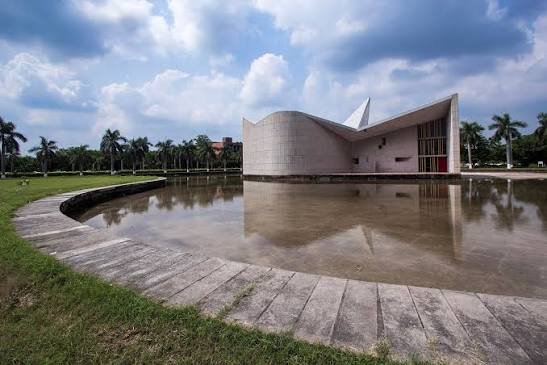
The Panjab University campus is also part of Chandigarh’s architectural heritage. Buildings such as Gandhi Bhawan, the A. C. Joshi Library and the Student Centre give the campus a distinctive identity.
For students, the university offers more than classrooms. Libraries, hostels, sports facilities, student societies, cultural activities and research centres contribute to an active campus environment.
Punjab Engineering College and Technical Education
Punjab Engineering College (Deemed to be University) is another important institution contributing to Chandigarh’s reputation as an education hub.
PEC has roots going back to 1921, when it was established as Mugalpura Engineering College in Lahore. After Partition, the institution moved to Roorkee and subsequently shifted to its present Chandigarh campus in 1953. It became a deemed-to-be university in 2003.
Today, PEC focuses strongly on engineering and technology education. Its current academic structure includes undergraduate B.Tech programmes, postgraduate M.Tech programmes and PhD programmes across engineering, science, management, humanities and social sciences. The institute also lists nine academic departments and two centres of excellence.
Its Sector 12 campus, located near the Shivalik Hills, adds another important academic landmark to Chandigarh’s northern educational landscape.
Medical Education at PGIMER
Chandigarh’s education ecosystem is not limited to conventional colleges and universities.
The Postgraduate Institute of Medical Education and Research (PGIMER) is one of the city’s most important institutions for medical education, healthcare and research.
PGIMER combines advanced patient care with postgraduate medical education and research. Its presence attracts medical students, doctors, researchers and healthcare professionals from different parts of India.
This combination of teaching, specialised healthcare and research strengthens Chandigarh’s position as a destination for professional and higher education.
Government Colleges in Chandigarh
Chandigarh also has a network of government colleges offering undergraduate and postgraduate programmes.
The Chandigarh Education Department currently lists institutions such as Government College for Boys, Government College for Girls, Government College of Commerce and Business Administration, Government Home Science College, Government College of Education and Government College, Sector 46, among others.
These colleges provide courses in subjects including:
- Arts
- Commerce
- Science
- Computer applications
- Business administration
- Education
- Home science
- Economics
- English
- History
- Biotechnology
- Information technology
- Physical education
The availability of multiple government institutions gives students additional choices at the undergraduate and postgraduate levels.
Chandigarh for Engineering Students
Students interested in engineering and technology have several options in the wider Chandigarh region.
PEC is the city’s most prominent specialised engineering institution, with programmes spanning multiple branches of engineering and technology. Its research ecosystem also provides opportunities for students interested in advanced technical studies.
The city also benefits from its proximity to other major educational institutions in the Chandigarh Tricity region, including institutions in Mohali and Panchkula.
This broader regional ecosystem means students can consider Chandigarh as part of a larger academic cluster rather than looking only within the municipal boundaries of the city.
Chandigarh for Commerce, Arts and Science Students
The city is equally relevant for students interested in traditional undergraduate disciplines.
Government and aided colleges offer programmes in arts, commerce and science, while Panjab University provides a much wider range of academic specialisations.
The Chandigarh Education Department’s current college information lists programmes such as B.A., B.Com., B.Sc., BCA, BBA, M.A., M.Com. and M.Sc. across different government colleges.
This diversity allows students to select an institution according to their academic interests, career plans and budget.
Research and Higher Education
A major characteristic of an education hub is the presence of research infrastructure, and Chandigarh has a strong academic research environment.
Panjab University has numerous research departments and centres, while PEC conducts research in engineering, science and interdisciplinary fields. PGIMER adds a major medical research component to the city’s academic ecosystem.
For postgraduate and doctoral students, this creates opportunities beyond conventional classroom education.
Research scholars can benefit from libraries, laboratories, specialised departments, academic conferences and collaborations between institutions.
Student Life in Chandigarh
Education is only one part of the Chandigarh student experience.
The city’s sector-based planning provides students with access to markets, libraries, parks, cafés, restaurants, sports facilities and cultural attractions.
Areas around Panjab University and major colleges have developed strong student communities. Sectors such as 15, 22, 34 and 35 are popular for food, shopping and everyday student needs, while several residential sectors provide PGs, hostels and shared accommodation.
The city’s relatively organised road network also makes daily commuting easier for many students.
Student Housing and Accommodation
The availability of accommodation is another factor that contributes to Chandigarh’s appeal as a student destination.
Students can choose between:
- University hostels
- Private PGs
- Shared flats
- Rental rooms
- Independent accommodation
Panjab University has a large hostel network, while PEC also provides hostel accommodation for its students.
Students who do not receive campus accommodation can explore nearby sectors based on their college location and budget.
Before choosing a PG or flat, students should compare rent, security deposits, food, electricity, internet, transport costs and other charges.
Libraries and Study Spaces
A strong academic city also needs places where students can study outside the classroom.
Chandigarh has several academic and public libraries. The A. C. Joshi Library at Panjab University is particularly important for university students and researchers, while public libraries such as the State Library in Sector 34 provide dedicated reading spaces.
PEC also has a specialised Central Library with technical resources and digital academic material.
These facilities are useful for students preparing for university examinations, entrance tests, competitive examinations and research projects.
Why Students Choose Chandigarh
There are several reasons students consider Chandigarh for higher education:
Established Institutions
The city has institutions with decades or even a century of educational history.
Diverse Courses
Students can study engineering, medicine, science, commerce, arts, management, education and other disciplines.
Planned Urban Environment
Chandigarh’s sector-based layout makes navigation and access to everyday services relatively convenient.
Student-Friendly Lifestyle
Markets, cafés, libraries, parks and recreational spaces create an active student environment.
Strong Academic Ecosystem
Universities, colleges, research institutions and specialised professional institutes operate within the city and the surrounding Tricity region.
Connectivity
Chandigarh’s location makes it accessible to students from Punjab, Haryana, Himachal Pradesh and other parts of North India.
What Makes Chandigarh Different from Other Education Cities?
Chandigarh combines education with planned urban development.
Unlike cities where educational institutions are concentrated in isolated university areas, Chandigarh’s colleges and institutions are integrated into a carefully planned city. Educational campuses exist alongside residential sectors, parks, commercial centres and public facilities.
The city’s modernist architectural heritage also makes its campuses distinctive. Panjab University’s buildings and PEC’s historic campus are examples of how education became part of Chandigarh’s broader urban vision.
Things Students Should Consider Before Choosing Chandigarh
Although Chandigarh offers many advantages, students should still compare institutions carefully before applying.
Consider:
- Course availability
- Eligibility criteria
- Entrance examinations
- Tuition fees
- Hostel availability
- Placement opportunities
- Faculty and academic reputation
- Research facilities
- Campus environment
- Distance from accommodation
- Cost of living
- Career opportunities after graduation
Admission requirements and course availability can change every academic session, so students should always verify details through the official institution before applying.
Future of Chandigarh as an Education Hub
Chandigarh’s education ecosystem continues to evolve.
Established institutions are expanding their academic and research activities, while new technologies are changing how students learn and collaborate.
PEC’s current academic and research activities, Panjab University’s broad research ecosystem and Chandigarh’s continuing development of higher-education infrastructure indicate that the city is likely to remain an important academic centre in North India.
The wider Chandigarh Tricity region also strengthens this position by connecting students with institutions and opportunities in Mohali and Panchkula.
Final Thoughts
Chandigarh as an education hub is defined by a combination of established institutions, diverse academic programmes, research opportunities, professional education and a student-friendly urban environment.
Panjab University provides a strong foundation in higher education and research, PEC adds a major engineering and technology component, PGIMER strengthens medical education and research, while government and aided colleges offer accessible programmes across arts, science, commerce and professional disciplines.
For students looking for an academic destination in North India, Chandigarh offers the advantage of combining quality education with organised city life, established campuses, libraries, accommodation options and a vibrant student culture.
That combination has helped Chandigarh build a distinctive identity as the City Beautiful and an important education hub in North India.
Dyal Singh College Karnal: A Legacy of Excellence in Education
Comments are closed.