
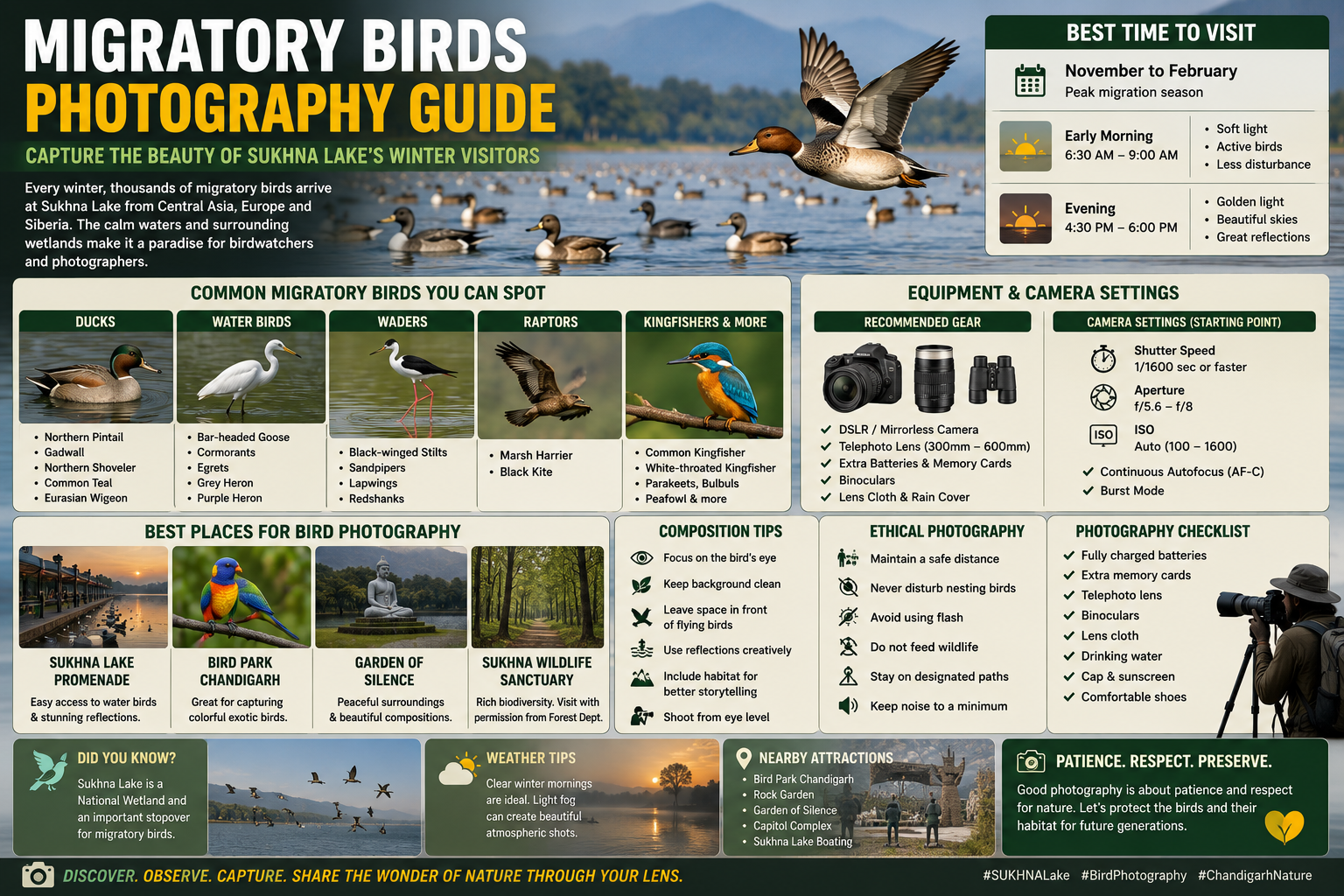
Migratory Birds Photography Guide: Capture the Beauty of Sukhna Lake’s Winter Visitors
Every winter, Sukhna Lake transforms into a paradise for birdwatchers and photographers as thousands of migratory birds arrive from Central Asia, Europe, Siberia, and the Himalayan region. The calm waters, surrounding wetlands, and protected forests create the perfect habitat for these seasonal visitors, making Chandigarh one of North India’s most rewarding destinations for wildlife photography.
Whether you’re a beginner using a smartphone or an experienced wildlife photographer with professional equipment, this Migratory Birds Photography Guide will help you capture stunning images while respecting nature and bird conservation.
Why Sukhna Lake Is a Bird Photography Hotspot
Situated at the foothills of the Shivalik Hills, Sukhna Lake provides an ideal environment for migratory birds thanks to its freshwater ecosystem, abundant food sources, and nearby protected forests.
The adjoining Sukhna Wildlife Sanctuary safeguards nearly 2,600 hectares of forest and wetland habitat, allowing birds to rest safely during their long migratory journeys. Every winter, thousands of birds stop here before continuing to other parts of India.
Because of its ecological importance, Sukhna Lake has also been recognized as a National Wetland, highlighting its role in bird conservation and biodiversity.
Best Time to Photograph Migratory Birds
Migratory Birds Photography Guide
The ideal bird photography season runs from:
November to February
During these months, Chandigarh experiences pleasant temperatures while migratory birds are present in large numbers.
The best time of day is:
Early Morning (6:30 AM – 9:00 AM)
Morning offers:
- Soft golden lighting
- Calm water
- Active birds feeding
- Less human activity
- Beautiful reflections
Evening can also provide excellent opportunities, especially during golden hour before sunset.
Common Migratory Birds You Can Spot
Although bird sightings vary each season, photographers often capture:
Ducks
- Northern Pintail
- Common Teal
- Gadwall
- Eurasian Wigeon
- Northern Shoveler
Water Birds
- Bar-headed Goose
- Greylag Goose
- Cormorants
- Egrets
- Herons
Waders
- Black-winged Stilts
- Sandpipers
- Lapwings
Raptors
- Marsh Harrier
- Black Kite
Alongside migratory birds, resident species such as kingfishers, parakeets, peafowl, and bulbuls add variety to your photography portfolio. Winter bird counts by local conservation groups regularly record dozens of species around Sukhna Lake and its surrounding wetlands.
Essential Camera Equipment
While professional gear helps, great bird photographs are possible with many modern cameras.
Recommended equipment:
Camera
- DSLR
- Mirrorless camera
- Advanced bridge camera
Lens
- 300mm
- 400mm
- 500mm
- 600mm
For beginners, even a 200mm zoom lens can produce excellent results.
Smartphones equipped with telephoto lenses can also capture surprisingly good images of nearby birds.
Camera Settings
Suggested starting settings:
- Shutter Speed: 1/1600 sec or faster
- Aperture: f/5.6–f/8
- ISO: Auto (100–1600)
- Continuous Autofocus (AF-C)
- Burst Mode enabled
For birds in flight, use higher shutter speeds to freeze movement.
Best Photography Locations
1. Sukhna Lake Promenade
The main promenade provides easy access to water birds and beautiful sunrise compositions.
Perfect for:
- Ducks
- Reflections
- Flight shots
- Landscape photography
2. Bird Park Chandigarh
Located near Sukhna Lake, Bird Park allows visitors to photograph colorful exotic birds in spacious walk-through aviaries.
Ideal for practicing wildlife photography techniques.
3. Garden of Silence
This peaceful location offers quieter surroundings where birds frequently perch along the shoreline.
The Buddha statue creates unique landscape compositions.
4. Sukhna Wildlife Sanctuary
With prior permission from the Forest Department, photographers can explore protected forest areas rich in birdlife and other wildlife.
Composition Tips
To improve your bird photographs:
- Focus on the bird’s eye.
- Keep the background uncluttered.
- Leave space in front of flying birds.
- Use reflections creatively.
- Include habitat for storytelling.
- Shoot from eye level whenever possible.
Natural compositions often produce more compelling images than tightly cropped portraits.
Ethical Wildlife Photography
Responsible photography is essential.
Always:
- Maintain a safe distance.
- Never disturb nesting birds.
- Avoid using flash.
- Do not feed wildlife.
- Stay on designated paths.
- Keep noise to a minimum.
Ethical practices protect both birds and their habitats.
Weather Conditions
Ideal weather includes:
- Clear winter mornings
- Light fog for atmospheric shots
- Calm winds
- Soft sunlight
Avoid photographing during heavy rain or dense afternoon haze.
Editing Your Photos
Post-processing should enhance rather than alter reality.
Basic adjustments include:
- Exposure correction
- White balance
- Slight sharpening
- Noise reduction
- Contrast adjustments
Avoid excessive editing that changes the bird’s natural appearance.
Photography Checklist
Before heading out:
✔ Fully charged batteries
✔ Extra memory cards
✔ Telephoto lens
✔ Lens cloth
✔ Drinking water
✔ Comfortable walking shoes
✔ Cap and sunscreen
✔ Binoculars (optional)
Nearby Attractions
Combine your bird photography trip with visits to:
- Bird Park Chandigarh
- Garden of Silence
- Rock Garden
- Capitol Complex
- Sukhna Lake Boating Area
These attractions are all located within a short distance.
Best Time of Year for Birdwatching
The peak migration season generally occurs between:
- Late November
- December
- January
- February
January often provides the highest diversity of migratory birds, making it the preferred month for wildlife photographers.
Why Sukhna Lake Is Every Bird Photographer’s Dream
Few urban locations in India offer the combination of accessibility, biodiversity, scenic landscapes, and peaceful surroundings that Sukhna Lake provides.
Whether you’re capturing a graceful Bar-headed Goose landing on calm waters, photographing a kingfisher diving for fish, or waiting patiently for ducks to glide across a golden sunrise, every visit offers new photographic opportunities.
For both amateur and professional photographers, Sukhna Lake remains one of Chandigarh’s greatest natural treasures.
Conclusion
Migratory bird photography at Sukhna Lake is more than simply taking pictures—it’s about observing nature, practicing patience, and appreciating one of Chandigarh’s richest ecosystems. With the right timing, equipment, and ethical approach, you can create stunning images while helping promote awareness about bird conservation.
Whether you’re visiting for the first time or returning every winter, Sukhna Lake continues to reward photographers with breathtaking wildlife encounters against the beautiful backdrop of the Shivalik Hills.
Read more on – https://topchandigarh.com/