
PEC Chandigarh Heritage: History, Architecture and Legacy
PEC Chandigarh Heritage is closely connected with the educational, architectural and historical development of Chandigarh. Punjab Engineering College, officially known as Punjab Engineering College (Deemed to be University), is one of the city’s oldest educational institutions and has a history that stretches back to 1921.
Today, the institute stands in Sector 12, close to the Shivalik Hills, on a large campus that combines academic buildings, hostels, open spaces and institutional facilities. Its heritage is not limited to its buildings. PEC’s story also reflects the Partition of India, the creation of Chandigarh and the evolution of technical education in the country.
History of PEC Chandigarh
The history of Punjab Engineering College Chandigarh begins in Lahore.
The institution was originally established as Mugalpura Engineering College in Lahore on November 9, 1921. It was later renamed Maclagan Engineering College and began functioning under that name in March 1924. In 1931, the college became affiliated with Punjab University, Lahore.
The Partition of India in 1947 changed the institution’s journey. After Partition, the college was shifted to Roorkee in India and was renamed East Punjab Engineering College. In 1950, the word “East” was dropped and the institution became known as Punjab Engineering College.
In late December 1953, PEC moved to its present campus in Chandigarh. It initially functioned under the Government of Punjab. When Chandigarh became a Union Territory in 1966, the institution came under the Chandigarh Administration.
This makes PEC’s history particularly significant because the institute was already an established engineering institution when Chandigarh was developing into India’s first planned modern city.
PEC and the Birth of Modern Chandigarh
PEC’s connection with Chandigarh is an important part of its heritage.
The college moved to Chandigarh in 1953, only a few years after the city was conceived as a new capital for Punjab. According to PEC, it was the first academic institution to come up in the new capital city of Chandigarh in 1953.
Its presence therefore forms part of the city’s early institutional development.
Chandigarh was planned around sectors, educational institutions, government buildings, residential neighbourhoods and green spaces. PEC became an important component of this educational landscape alongside institutions such as Panjab University and other major colleges.
PEC Campus and Its Heritage Character
The PEC Chandigarh campus is located in Sector 12 at the northern end of the city, close to the Shivalik Hills.
PEC’s current institutional information describes the campus as covering approximately 146 acres and containing different functional zones, including the Main College Building, Administration Block, hostels, residential areas and a shopping centre.
The combination of academic buildings, mature greenery and open areas gives the campus a distinctive institutional character.
For people interested in Chandigarh’s architectural history, PEC offers a different experience from famous attractions such as the Capitol Complex, Rock Garden and Panjab University. It represents the city’s educational architecture and the growth of its academic institutions.
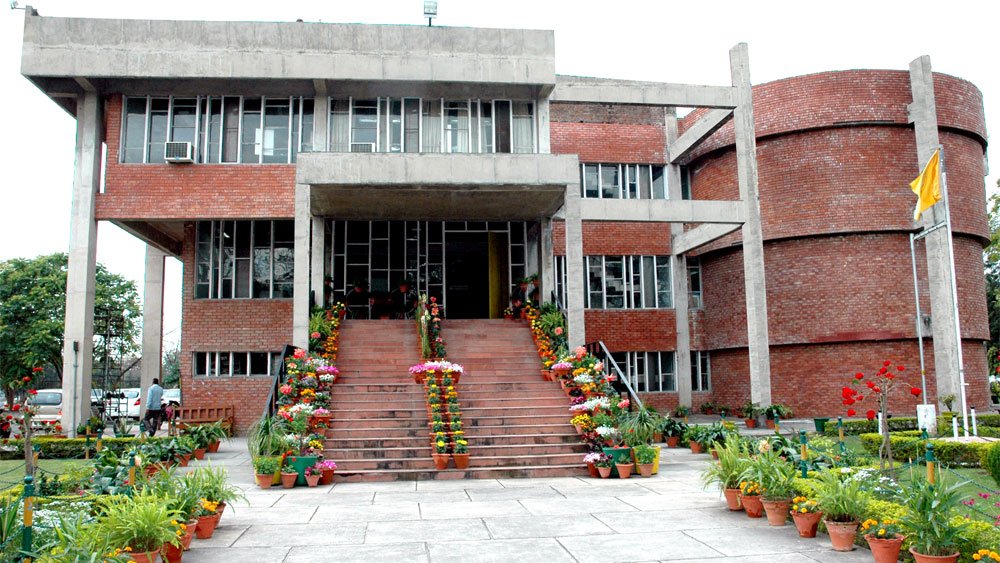
The Main College Building
The Main College Building is one of the central elements of the PEC campus.
Rather than viewing the building simply as an academic facility, it can be understood as part of the institution’s long journey in Chandigarh. Generations of engineering students have passed through its academic spaces, making the building an important part of PEC’s collective memory.
The campus has changed over the decades as new facilities have been added, but the original institutional identity remains an important part of its heritage.
PEC and Chandigarh’s Educational Heritage
PEC has played a significant role in Chandigarh’s reputation as an education hub.
The city is home to major institutions covering engineering, medicine, architecture, arts and other disciplines. PEC’s long-standing focus on technical education has contributed to this identity.
The institute currently offers undergraduate, postgraduate and doctoral programmes and has nine academic departments and centres focused on research and innovation.
This combination of heritage and modern education is one of the most interesting aspects of PEC today.
From Engineering College to Deemed University
PEC’s institutional status has evolved significantly over the years.
In 2003, the Government of India notified Punjab Engineering College as a Deemed to be University. The institution was later known as PEC University of Technology before returning to the name Punjab Engineering College (Deemed to be University).
The transition reflects how the institution expanded beyond its earlier role as an engineering college.
Today, PEC combines undergraduate and postgraduate education with doctoral programmes and research across engineering, science, management, humanities and social sciences.
PEC’s 100-Year Heritage
PEC reached an important milestone in 2021, completing 100 years since its establishment in Lahore in 1921.
The institute celebrated its centenary on November 9, 2021. A commemorative event was held on November 16, 2021, with then-President of India Ram Nath Kovind as the chief guest. During the celebrations, a special postage stamp featuring the institute’s historical Lahore campus and present Chandigarh campus was unveiled.
The centenary celebrations also highlighted the institution’s archives, alumni, former directors and important moments from its century-long history.
A documentary and Coffee Table Book were released to preserve and showcase significant episodes from PEC’s past. The collection included archival photographs, stories of alumni, biographies and historic documents.
PEC Alumni and Legacy
An important part of PEC heritage is its alumni network.
Over more than a century, the institution has produced graduates who have contributed to engineering, science, technology, administration, industry and other fields.
PEC itself describes its long history as producing numerous alumni who have earned recognition for themselves and the institute.
The alumni legacy adds another dimension to the campus. Heritage is not only about buildings and dates; it is also about the people who studied, taught and worked there.
PEC’s Heritage in the Present Day
Although PEC has a long history, it continues to function as a modern technical institution.
Its current academic structure includes B.Tech, M.Tech, PhD and other programmes, while its departments and centres are involved in research and collaborations with industries, research organisations and academic institutions.
The institute’s official website also highlights contemporary student activities, technical societies, cultural clubs and research initiatives.
This balance between history and innovation is central to understanding PEC Chandigarh today.
Why PEC Chandigarh Heritage Matters
There are several reasons why PEC Chandigarh heritage deserves attention:
- It was established more than a century ago.
- Its roots lie in pre-Partition Lahore.
- It moved through Roorkee before arriving in Chandigarh.
- It was among the earliest academic institutions in Chandigarh.
- Its campus is part of the city’s institutional landscape.
- It has contributed to technical education in India for generations.
- Its alumni form an important part of its legacy.
- Its centenary preserved important historical records and memories.
- It continues to operate as a modern educational and research institution.
Exploring PEC Chandigarh
PEC is primarily an active educational institution rather than a conventional tourist attraction. Anyone interested in its heritage should therefore respect campus rules and academic activities.
For architecture and Chandigarh-history enthusiasts, the surrounding Sector 12 area can also be explored alongside other nearby educational landmarks.
A visit can be particularly meaningful when combined with an understanding of PEC’s history—from Mugalpura in Lahore to Roorkee and finally Chandigarh.
Final Thoughts
The story of PEC Chandigarh heritage is essentially a story of continuity and transformation.
Founded as Mugalpura Engineering College in Lahore in 1921, the institution survived the upheaval of Partition, moved to Roorkee and eventually established itself in Chandigarh in 1953. Over the decades, it evolved from an engineering college into a deemed university while maintaining its strong connection with technical education.
Today, PEC remains an important part of Chandigarh’s educational identity. Its campus, alumni, architecture, institutional memories and century-long history make it much more than an engineering college. It is a living piece of the heritage of Chandigarh—one that continues to educate new generations while preserving a remarkable link to India’s past.
PGI Chandigarh Guide: Departments, OPD, Emergency, Location and Patient Services
Comments are closed.