
Tree-Lined Avenues and Green Planning: How Chandigarh Became India’s Greenest Planned City
From the earliest planning stages by Le Corbusier, Pierre Jeanneret, and landscape experts like Dr. M.S. Randhawa, nature was integrated into every aspect of urban design. Today, initiatives such as the green network in Chandigarh development plan and the greening Chandigarh action plan continue to preserve and expand this remarkable green legacy.
Table of Contents
ToggleThe Vision Behind Chandigarh’s Green Planning
When Chandigarh was planned in the early 1950s, it was envisioned as much more than a capital city. Le Corbusier believed that a healthy city required a harmonious balance between architecture, transportation, open spaces, and nature.
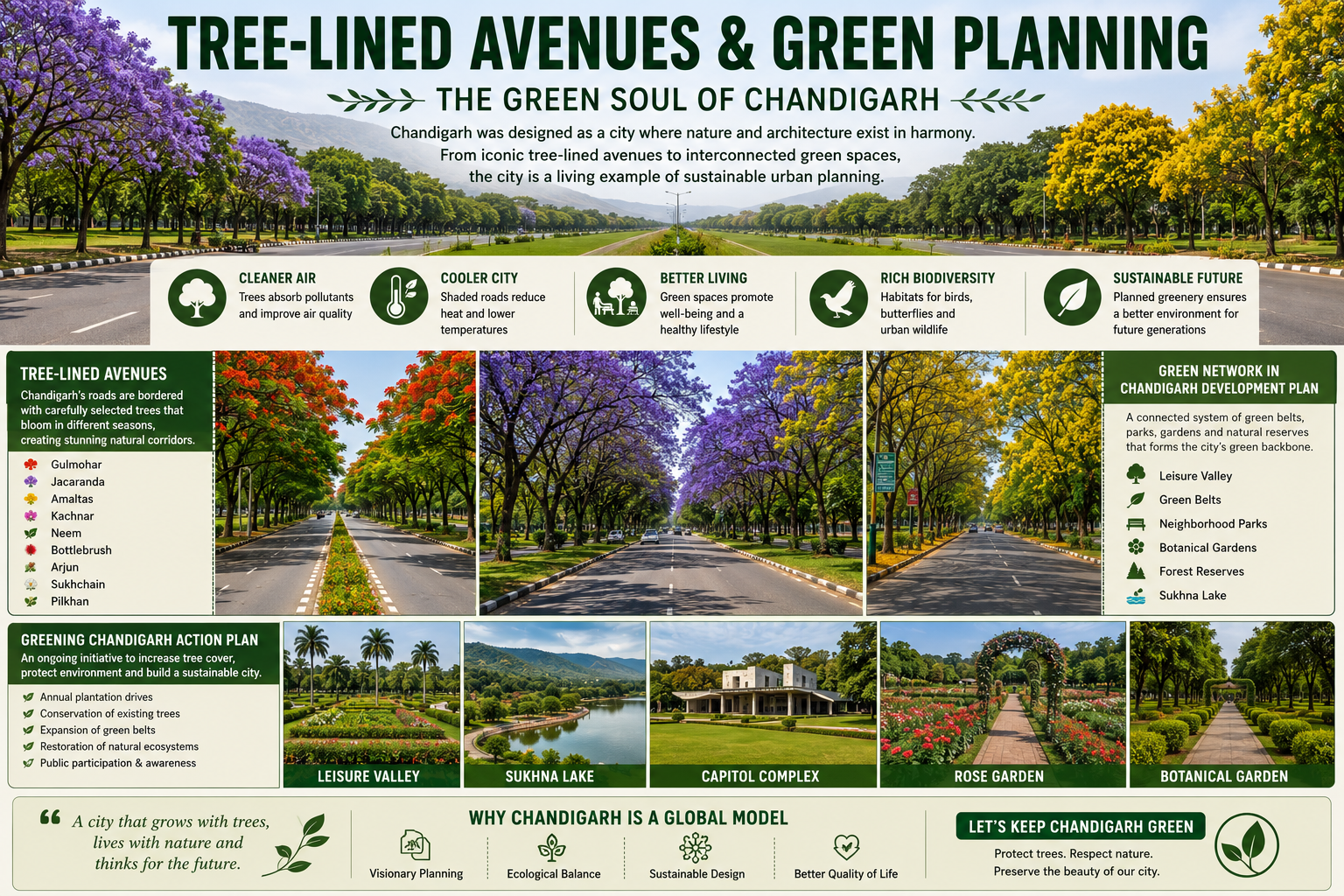
Rather than treating trees as decorative additions, planners designed roads around them. Every major boulevard was intended to become a tree lined avenue, creating shaded streets that improved comfort while enhancing the city’s visual identity. The original planning philosophy also emphasized interconnected green belts and parks, a concept that remains central to the green network in Chandigarh development plan today.
What Makes Chandigarh’s Tree-Lined Avenues Special?
Unlike most Indian cities, Chandigarh’s roads were planted with specific tree species based on their flowering seasons, canopy size, and ecological value.
Some of the most common avenue trees include:
- Gulmohar
- Jacaranda
- Amaltas (Golden Shower Tree)
- Neem
- Kachnar
- Bottlebrush
- Arjun
- Sukhchain
- Pilkhan
Each tree lined avenue was planned to provide seasonal color, natural shade, and visual continuity across sectors.
During spring, roads bloom with vibrant yellow, purple, red, and pink flowers, transforming everyday streets into scenic corridors.
The Green Network in Chandigarh Development Plan
One of Chandigarh’s greatest planning achievements is its interconnected system of green spaces.
The green network in Chandigarh development plan links:
- Leisure Valley
- Green belts
- Neighborhood parks
- Botanical gardens
- Forest reserves
- Sukhna Lake
- Tree-lined roads
Instead of isolated parks, the city functions as one continuous green ecosystem where wildlife, pedestrians, and cyclists can move through connected landscapes. This integrated approach improves biodiversity, reduces urban heat, and supports sustainable mobility.
Leisure Valley: The City’s Green Spine
Stretching across several sectors, Leisure Valley acts as Chandigarh’s central green corridor.
This landscaped belt connects multiple themed gardens, including:
- Zakir Hussain Rose Garden
- Bougainvillea Garden
- Garden of Fragrance
- Shanti Kunj
- Smriti Upavan
- Topiary Park
It forms an essential component of the green network in Chandigarh development plan, demonstrating how parks can be interconnected rather than developed as isolated recreational spaces.
Greening Chandigarh Action Plan
To preserve its green identity, the administration regularly implements the greening Chandigarh action plan, an ongoing program focused on increasing forest cover, protecting existing trees, expanding urban forestry, and encouraging public participation in plantation drives. The plan sets annual plantation targets, identifies suitable species for different locations, and promotes conservation of green belts, roadsides, and reserve forests.
Key objectives include:
- Increasing urban tree cover
- Expanding green belts
- Conserving biodiversity
- Restoring degraded landscapes
- Protecting Sukhna Lake’s catchment
- Encouraging citizen participation
- Promoting environmental awareness
The greening Chandigarh action plan has become one of India’s longest-running urban greening initiatives, helping maintain the city’s reputation as the “City Beautiful.”
Environmental Benefits of Tree-Lined Roads
Every tree lined avenue contributes significantly to Chandigarh’s environmental health.
Major benefits include:
- Lower surface temperatures
- Cleaner air
- Reduced dust pollution
- Improved rainwater absorption
- Carbon sequestration
- Habitat for birds and butterflies
- Reduced urban heat island effect
Large tree canopies also make walking and cycling far more comfortable during Chandigarh’s hot summers.
Jan Marg: Chandigarh’s Iconic Green Boulevard
One of the finest examples of a tree lined avenue is Jan Marg, the ceremonial road connecting the city center to the Capitol Complex.
Designed as part of Le Corbusier’s master plan, Jan Marg is celebrated for its grand scale, mature tree canopy, and visual alignment with the Shivalik Hills. Heritage walks and conservation efforts continue to highlight its ecological and cultural importance.
Biodiversity Beyond Landscaping
The city’s green planning supports a remarkable variety of wildlife.
Residents frequently observe:
- Parakeets
- Kingfishers
- Bulbuls
- Peacocks
- Butterflies
- Honeybees
- Migratory birds
These thriving ecosystems demonstrate how the green network in Chandigarh development plan extends beyond aesthetics to create functional habitats for urban biodiversity.
Challenges and Conservation Efforts
Rapid urbanization, increasing traffic, and infrastructure development pose ongoing challenges to Chandigarh’s green identity.
In response, authorities continue implementing the greening Chandigarh action plan, while environmental groups actively advocate for preserving mature avenue trees, restoring missing plantations, and protecting the city’s historic green corridors. These collaborative efforts aim to ensure that future development remains compatible with Chandigarh’s original planning philosophy.
Best Places to Experience Chandigarh’s Green Planning
Visitors interested in the city’s landscape design should explore:
- Jan Marg
- Leisure Valley
- Sukhna Lake
- Capitol Complex
- Chandigarh Botanical Garden & Nature Park
- Rose Garden
- Rajendra Park
Together, these destinations showcase the success of Chandigarh’s integrated green planning model.
Why Chandigarh Remains a Global Model
Very few planned cities have successfully combined architecture, transportation, ecology, and landscape design as effectively as Chandigarh.
The city’s extensive tree lined avenue system, connected green corridors, and forward-thinking environmental policies continue to inspire urban planners worldwide. Combined with the green network in Chandigarh development plan and the ongoing greening Chandigarh action plan, Chandigarh demonstrates that sustainable urban development and natural beauty can coexist.
Conclusion
Chandigarh’s green identity is no accident—it is the result of visionary planning, thoughtful landscaping, and decades of environmental stewardship. From every tree lined avenue to the interconnected parks and green belts established through the green network in Chandigarh development plan, the city exemplifies how nature can be woven into urban life.
Supported by the long-running greening Chandigarh action plan, these initiatives ensure that Chandigarh remains one of India’s greenest and most livable cities. Whether you’re strolling beneath flowering avenue trees, exploring Leisure Valley, or enjoying the shaded boulevards framed by the Shivalik Hills, you’ll discover why Chandigarh continues to set the benchmark for sustainable city planning.