
Why Chandigarh Is a Master-Planned City: The Vision That Changed Urban India
Why Chandigarh Is a Master-Planned City
When people talk about India’s best-planned city, one name consistently stands out—Chandigarh. Built after India’s independence and designed by world-renowned architect Le Corbusier along with Pierre Jeanneret, Jane Drew, and Maxwell Fry, Chandigarh was envisioned as a symbol of modern India. More than seven decades later, it continues to be studied by architects, urban planners, and governments across the world.
But what exactly makes Chandigarh different from other cities? The answer lies in its thoughtful planning, organized sectors, road hierarchy, green infrastructure, and human-centered design. This is why Chandigarh is a master-planned city and remains one of the most successful urban planning experiments of the twentieth century.
The Historical Need for a Planned City
After the Partition of India in 1947, Punjab lost its historic capital, Lahore, to Pakistan. India needed a new administrative capital for East Punjab. Rather than expanding an existing city, the government decided to build an entirely new one from the ground up.
Prime Minister Jawaharlal Nehru wanted the city to represent a progressive and forward-looking nation. Chandigarh became that symbol. This historical context is one of the primary reasons why Chandigarh is a master-planned city—it was designed with a clear purpose from the very beginning rather than growing organically over centuries.
A City Designed Like the Human Body
One of the most fascinating aspects of Chandigarh’s planning is Le Corbusier’s famous “human body” analogy.
According to the master plan:
- The Capitol Complex represents the Head.
- Sector 17 serves as the Heart.
- Leisure Valley and green spaces function as the Lungs.
- Educational institutions form the Intellect.
- Industrial areas represent the Viscera.
- Roads and transportation networks act as the Circulatory System.
This integrated vision demonstrates why Chandigarh is a master-planned city. Every component was designed to perform a specific function while contributing to the overall health of the urban environment.
The Sector System: Chandigarh’s Greatest Innovation
The foundation of Chandigarh’s planning is its sector-based layout. Instead of creating large, unorganized neighborhoods, the city was divided into self-sufficient sectors measuring approximately 800 meters by 1200 meters.
Each sector includes:
- Residential areas
- Markets
- Schools
- Parks
- Healthcare facilities
- Places of worship
This design allows residents to access daily necessities within walking distance. The sector model remains one of the strongest examples of neighborhood planning in the world.
Many urban planning experts believe that this self-contained approach is a major reason why Chandigarh is a master-planned city that continues to function efficiently decades after its creation.
The Revolutionary 7V Road Network
Traffic management is another defining feature of Chandigarh.
Le Corbusier introduced a hierarchy of roads known as the 7V system, where each category serves a specific purpose:
- V1: Regional highways
- V2: Major city roads
- V3: Sector-dividing roads
- V4: Shopping streets
- V5: Distribution roads
- V6: Residential streets
- V7: Pedestrian pathways
This separation of traffic types minimizes congestion and improves safety. Unlike many cities where commercial, residential, and through traffic mix together, Chandigarh’s transportation network was designed for efficiency from the start.
Green Spaces as Urban Infrastructure
Chandigarh is often called one of India’s greenest cities.
Le Corbusier believed that open spaces were as important as buildings. As a result, the city includes:
- Leisure Valley
- Sector parks
- Tree-lined avenues
- Green belts
- Sukhna Lake surroundings
- Public gardens
The extensive network of greenery improves air quality, enhances aesthetics, and contributes to residents’ well-being.
Unlike many modern urban developments where parks are treated as leftover spaces, Chandigarh incorporated green infrastructure into its original master plan. This holistic approach further explains why Chandigarh is a master-planned city admired worldwide.
Architecture With a Purpose
The city’s architecture was designed to reflect modernity, functionality, and democracy.
Landmarks such as:
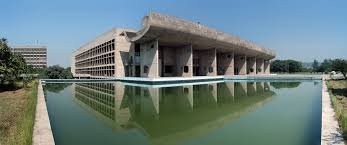
- Capitol Complex
- High Court
- Secretariat
- Legislative Assembly
- Open Hand Monument
were created not only as buildings but also as symbols of governance and national progress.
In 2016, the Capitol Complex was recognized as a UNESCO World Heritage Site as part of “The Architectural Work of Le Corbusier.” This international recognition reinforced Chandigarh’s importance in the history of modern architecture.
Adaptability and Long-Term Vision
A truly successful city must evolve with changing needs. Chandigarh has expanded beyond its original sectors while retaining its planning principles. Additional sectors, housing developments, educational institutions, and commercial centers have been integrated into the city’s framework over time.
Even today, planners reference Chandigarh when discussing sustainable growth, neighborhood planning, and transportation management.
Its ability to remain functional despite population growth is a testament to the strength of its original design.
Lessons Modern Cities Can Learn
As cities across the world struggle with traffic congestion, pollution, overcrowding, and unplanned expansion, Chandigarh offers valuable lessons:
- Plan before development begins.
- Prioritize people over vehicles.
- Preserve green spaces.
- Create self-sufficient neighborhoods.
- Maintain clear land-use patterns.
- Integrate transportation and urban design.
These principles remain relevant in contemporary urban planning and continue to influence new city developments globally.
Conclusion
The answer to why Chandigarh is a master-planned city lies in its remarkable combination of vision, functionality, sustainability, and architectural excellence. Every sector, road, park, and public institution was carefully designed to contribute to a larger urban ecosystem.
More than seventy years after its creation, Chandigarh remains a benchmark for city planning not only in India but around the world. Its sector-based layout, efficient transportation system, abundant green spaces, and iconic architecture continue to demonstrate what can be achieved when urban development is guided by thoughtful planning rather than uncontrolled growth.
For residents, visitors, architects, and urban planners alike, Chandigarh remains a living example of how a city can be beautiful, organized, and sustainable all at the same time.