India is home to thousands of majestic waterfalls cascading down ancient mountain ranges, from the mist-covered rainforests of the Western Ghats to the high-rainfall plateaus of Meghalaya. Whether you are preparing for competitive civil service exams (UPSC, SSC, State PSC) or planning an eco-tourism journey, one geographical question is searched frequently:
Which is the highest waterfall in India?
The official answer is Kunchikal Falls, located in the Shivamogga district of Karnataka, standing at an extraordinary height of 455 meters (1,493 feet). In this comprehensive guide, we cover the exact height, river origin, location facts, visiting guidelines, and a complete ranking of the top 10 tallest waterfalls across India.
2. Anatomy of Kunchikal Falls: Why It Reaches 455 Meters
Kunchikal Falls is a multi-tiered cascade. Instead of plunging into a single vertical leap, the Varahi River rushes down a series of massive rocky ledges and granite boulders across a steep slope in the Agumbe rainforest corridor. Together, these continuous cascades span an elevation drop of 455 meters, securing Kunchikal’s title as the tallest waterfall in India and one of the highest in Asia.
3. The Varahi River & Hydroelectric Infrastructure
Kunchikal Falls is formed by the Varahi River, a perennial river that originates in the dense forests of the Western Ghats. Following the construction of the Mani Dam and the Varahi Hydroelectric Project (KPCL) upstream, much of the river’s natural volume is regulated for power generation. As a result, the roaring majesty of Kunchikal Falls is visible at full strength during the peak monsoon season (July to September), when the dam overflow fills the natural gorge.
4. Is Kunchikal Falls Open to Tourists?
Because Kunchikal Falls lies within a protected reserve forest and a high-security hydroelectric power zone, direct public entry to the base of the waterfall is strictly regulated. Travelers require prior gate passes from the Karnataka Forest Department or Karnataka Power Corporation Limited (KPCL). Most visitors experience the scenic waterfall view from designated forest ridges near Mastikatte or visit neighboring accessible waterfalls like Jog Falls, Barkana Falls, and Onake Abbi Falls.
5. Highest vs. Tallest Single-Drop: Clearing the Confusion
In Indian geography and exam curricula, students and travelers often confuse waterfall classifications. Here is the exact scientific distinction:
Tallest Waterfall in India (Overall Elevation):Kunchikal Falls (455 m) in Karnataka – A multi-tiered cascade.
Tallest Single-Drop Plunge Waterfall:Nohkalikai Falls (340 m / 1,115 ft) in Meghalaya – The water falls straight down in a single unbroken sheet.
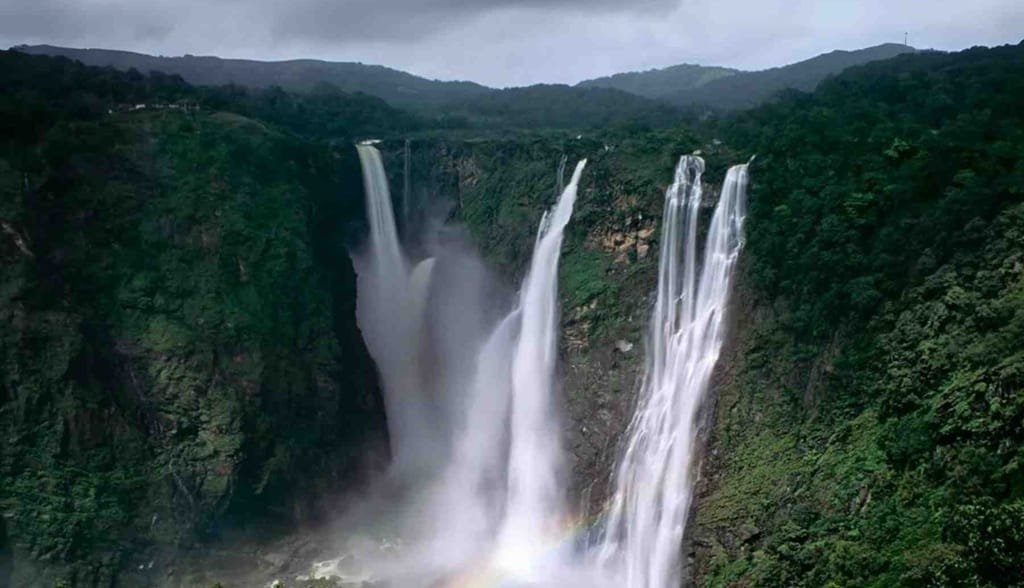
Highest Segmented Waterfall:Jog Falls (253 m / 830 ft) in Karnataka – Consisting of four distinct streams (Raja, Roarer, Rocket, and Rani) on the Sharavathi River.
6. Top 10 Highest Waterfalls in India (Official Height Ranking)
Rank
Waterfall Name
Height (Meters / Feet)
State
River / Type
1
Kunchikal Falls
455 m (1,493 ft)
Karnataka
Varahi River (Tiered)
2
Barehipani Falls
399 m (1,309 ft)
Odisha
Budhabalanga River (Two-tiered)
3
Nohkalikai Falls
340 m (1,115 ft)
Meghalaya
Plunge Waterfall (Single Drop)
4
Nohsngithiang Falls (Seven Sisters)
315 m (1,033 ft)
Meghalaya
Segmented Cascade
5
Dudhsagar Falls
310 m (1,017 ft)
Goa / Karnataka border
Mandovi River (4-Tiered)
6
Kynrem Falls
305 m (1,001 ft)
Meghalaya
Three-Tiered Cascade
7
Meenmutty Falls
300 m (984 ft)
Kerala (Wayanad)
Chaliyar River Basin (Tiered)
8
Thalaiyar Falls (Rat Tail)
297 m (974 ft)
Tamil Nadu (Dindigul)
Manjalar River (Horsetail)
9
Barkana Falls
259 m (850 ft)
Karnataka (Agumbe)
Sita River (Tiered)
10
Jog Falls (Gerosoppa)
253 m (830 ft)
Karnataka
Sharavathi River (Segmented)
7. Ecological Significance of Indian Waterfalls
India’s high waterfalls are vital ecological engines for regional biodiversity:
Clean Hydroelectric Power: The immense head pressure of rivers like the Varahi and Sharavathi drives clean renewable energy across Karnataka and South India.
Microclimatic Regulation: Waterfalls spray fine mist across canopy rainforests, supporting endemic mosses, orchids, amphibians, and the King Cobra in regions like Agumbe.
Eco-Tourism Lifeline: Accessible waterfalls create vital livelihood networks for local forest guides, homestays, and sustainable transport operators.
Frequently Asked Questions (FAQs)
What is the highest waterfall of India?
The highest waterfall in India is Kunchikal Falls, situated in the Shivamogga district of Karnataka, with a height of 455 meters (1,493 feet).
Which is the tallest single-drop plunge waterfall in India?
Nohkalikai Falls near Sohra (Cherrapunji) in Meghalaya is India’s tallest plunge waterfall, featuring an unbroken single vertical drop of 340 meters (1,115 feet).
Is Jog Falls taller than Kunchikal Falls?
No. Jog Falls stands at 253 meters, while Kunchikal Falls is significantly taller with a cumulative tiered drop of 455 meters.
Which state has the most number of high waterfalls in India?
Karnataka and Meghalaya dominate India’s waterfall geography, housing 7 of the 10 tallest waterfalls in the country.


 India’s high waterfalls are vital ecological engines for regional biodiversity: